It All Adds Up: An Example of Using SAMR and TPACK in the English/Language Arts Classroom to Teach Creative Writing
But First, a Quick Look at Pedagogy...Learning Theories that Help Inform Instruction
If you Google "pedagogy," this is the definition that pops up:
ped·a·go·gy
Dictionary result for pedagogy
/ˈpedəˌɡäjē/
noun
- the method and practice of teaching, especially as an academic subject or theoretical concept.
"the relationship between applied linguistics and language pedagogy"
So, the pedagogical theory that a teacher adopts shapes the methods and best practices a teacher uses to deliver instruction. A quick rundown of the five most common pedagogies taught in Teacher Education Programs are:
Behaviorism: As you might expect, this theory posits that people are blank slates (tabula rasa), and that how they behave can be influenced positively or negatively by external stimuli. Want your students to sit quietly? Give a positive reward to those who are sitting quietly, and give a negative reward to those who aren't. Positively reward students who are getting good grades, and negatively reward those who aren't. Ideally, students will start to exhibit the behaviors that give them positive rewards, and abandon those behaviors that don't.
Cognitivism: As the name suggests, the mind is the motivator in this learning theory. People are rational beings who need to be active participants in their learning. The mind is often compared to a computer: information comes in, is processed, and leads to certain outcomes. I think it won't surprise anyone to find out that this theory was becoming popular as computers were becoming more valuable to science.
Constructivism: Students construct their learning based on their personal experiences. Students make sense of what they're learning by connecting it to what they have already learned, either in school or through experience. It's important to connect what you want to teach to what a student already knows.
Critical Learning Theory (Pedagogy of the Oppressed): Educators and educands (a term coined to replace "student") can both learn from each other. The danger in education is that it can be used to keep a caste system in place, if both educators and educands don't think critically about what is being taught, and why it's being taught. Education should be a way to eliminate barriers to opportunities, not keep opportunity only for those deemed wealthy or worthy enough.
Social Learning Theory: People learn best from each other, through observation, imitation, and modelling. Social interaction can be a powerful way for students to learn. Students at different levels of learning can work together to bring everyone to an understanding of concepts and skills.
I'm working towards blending Constructivism and Social Learning Theory in my teaching. I think that students can bring a lot to their education, and I know that even within a novice-level class, you quickly get students at different levels of understanding. Why not have students reinforce concepts to each other? I also like to keep the Critical Learning Theory in the forefront of my mind, to keep myself from falling into the trap of thinking I'm all-knowing, and only I can deliver the content.
Now that we have that out of the way, how do we use TPACK and SAMR to teach creative writing?
Although I teach Spanish, I think that creative writing is one of the ultimate collaborative tasks--the writer might be alone as they write the story, but they have to keep their audience in mind--who are the people they want reading their story? Plus, I hope that a writer involves beta readers (those people who read a story as it's being written, or just after it's been written to make sure that the story makes sense), proofreaders (people who check for spelling, word choice, grammar, and typographical errors), and editors (those who read stories and make suggestions for revision to make the story more appealing to the reader). Plus, there are so many tech tools out there for all sorts of (ahem) creative teaching.
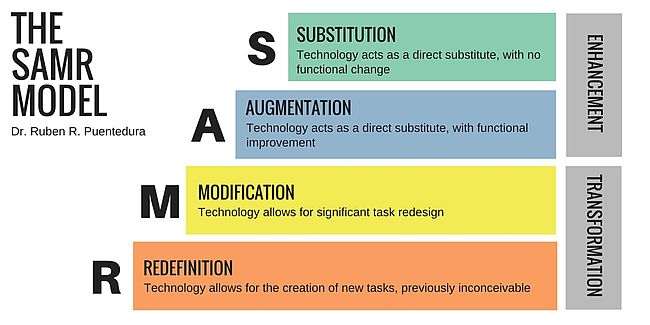
SUBSTITUTION
You know all those worksheets you give your students to fill out for character development, plot/rising action/resolution, etc? Even if you give your students a folder to put them in, what usually happens? "[Teacher], I lost my worksheet! I can't remember what was supposed to go next!" Instead of handing out worksheets, why not create a document, using GoogleDocs, MS Word, or Pages (Apple's word processing program). Students can create a folder on their devices desktop to keep them all, they can be uploaded to you for review, or even shared to another student for peer review. You save time and trees and students won't be as frustrated when they can't find the paper they need.
Another good substitution tool for a story map is Read-Write-Think's Cube Creator. I used the Trading Card creator last year, and it was a little tricky sharing and saving it, but my students last year seemed to like it. (The Trading Card Creator could also be good to use for character creation.)
Word clouds, such as Tagxedo, Wordle, and Wordsift, can be used as brainstorming tools. Post a link to a word cloud, and have students suggest ideas. Maybe you want to review the elements of a story, or positive (or negative) character traits. The more a word is used, the bigger it appears in the cloud.
Mindmapping tools, such as Bubbl.us, can be used for character development, plotting, designing the elements of a story, or anything else you can think of in the pre-writing phase.
AUGMENTATION
I'm going to suggest using a word cloud as an editing tool--have students copy and paste a selection from their story to check if they're overusing a word. I have a lot of author friends, and a lot of teacher friends, and even a few author-friends-who-are-also-teacher-friends on Facebook and sometimes links for overused words ("Don't use very, use ___") are posted. I thought using a word cloud to check for those overused words might be a quick, easy editing tool. Students could then be referred to an online thesaurus (substitution tool) to find a better word.
Pic-Lits, in their own words, is "on-line version of refrigerator poetry makers." Depending on what kind of creative writing you wanted your students to do, this could be a quick way to get the creative juices flowing, or it could be used to create haiku, or poetry. Students can either drag-and-drop from word lists (could also be a way to expand vocabulary), or they can "freewrite."
MODIFICATION
PowerPoint, or any other "slideshow" presentation tool (such as Google Slides, or Canva) can be used either as an augmentation, or as a modification tool. If all students do is add pictures to their text, and use the transitions and animations, then this would be an augmentation. However, if they embed video to go with their text, or add background music to their presentation, that would kick it up to a modification.
Make Beliefs Comix is an on-line comic strip maker. Students can create multi-panel comic strips, using the site's "cast of characters," backgrounds, and objects to tell their story. Could also be used as as storyboards for a longer story.
REDEFINITION
Wixie is an authoring tool. (BCPS has a site license, but anyone can use it--for a fee) Students can create presentations through "their writing, their voice, and their art."
Another way to redefine their creative writing is to have students create videos of their stories. Most computers have some kind of movie making program. Students could also collaborate to bring their stories to life--acting, directing, costume-making, music! Or students could use the movie maker to make a book trailer for their story.